Reliability Scoring
Last updated: June 3, 2026
Reliability Scoring is Nash's continuous, real-time measure of how dependably a provider fulfills deliveries. It directly determines the volume and type of work you receive: higher scores mean more offers.
How your score is calculated
Your Reliability Score updates continuously — recent jobs carry more weight than older ones. Nash looks back 180 days, but a job from last week counts far more than one from five months ago.
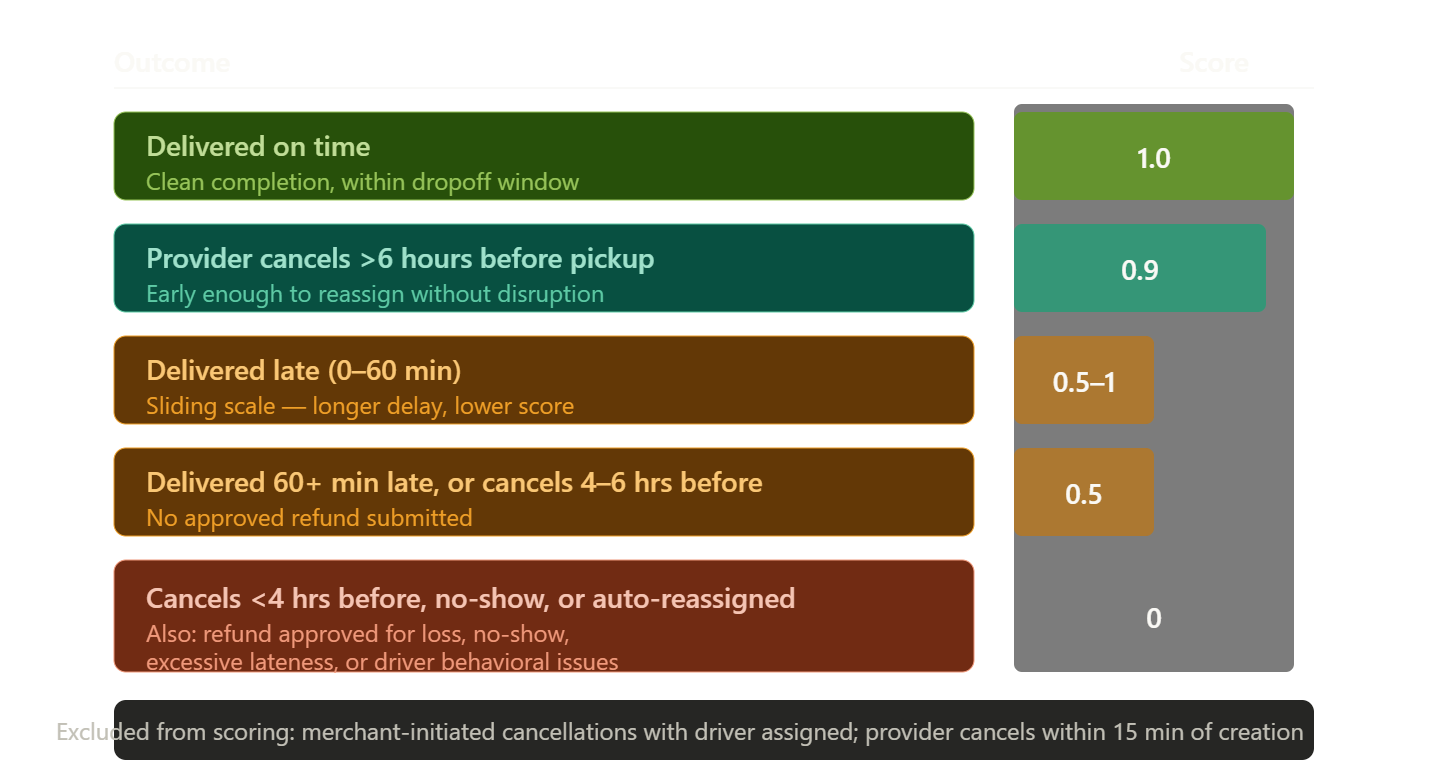
Each job earns a score based on its outcome: a clean, on-time delivery scores 1.0; a late delivery slides down from 1.0 to 0.5 depending on how late (0–60 minutes); a delivery completed more than 60 minutes late scores 0.5; a cancellation 4–6 hours before pickup scores 0.5; one more than 6 hours before pickup scores 0.9; and a same-day cancellation under 4 hours, a no-show, or a refund approved for loss or driver behavioral issues scores 0. Some jobs are excluded from scoring entirely — including merchant-initiated cancellations when a driver is already assigned, and provider cancellations within 15 minutes of job creation. Those per-job scores are aggregated across your 180-day history, with freshness decay ensuring your most recent performance is always what drives your standing.
Completion rate counts only jobs abandoned without a documented exception. If a driver properly logs an exception in the app (recipient not home, invalid address), the job does not count against you. Issue rate is inverted in the formula: 1.5% issue rate contributes 98.5 to the score.
Performance tiers
Tier | Score |
|---|---|
Preferred | 90–100 |
Standard | 78–89 |
Monitored | 65–77 |
At risk | Below 65 |
Viewing your score
Analytics > Performance > Performance Metrics in the provider portal shows your current composite score. Set the Dimension to city to get a solid representation of your score during dispatching with Nash merchants.
Improving a low score
Address the specific dimension driving the drop. Late pickups almost always indicate a driver dispatch gap. Low completion rates usually point to undocumented abandonment. High issue rates call for a review of your job-level logs, since most incidents cluster around specific conditions.
For questions, contact your Nash partner success manager.